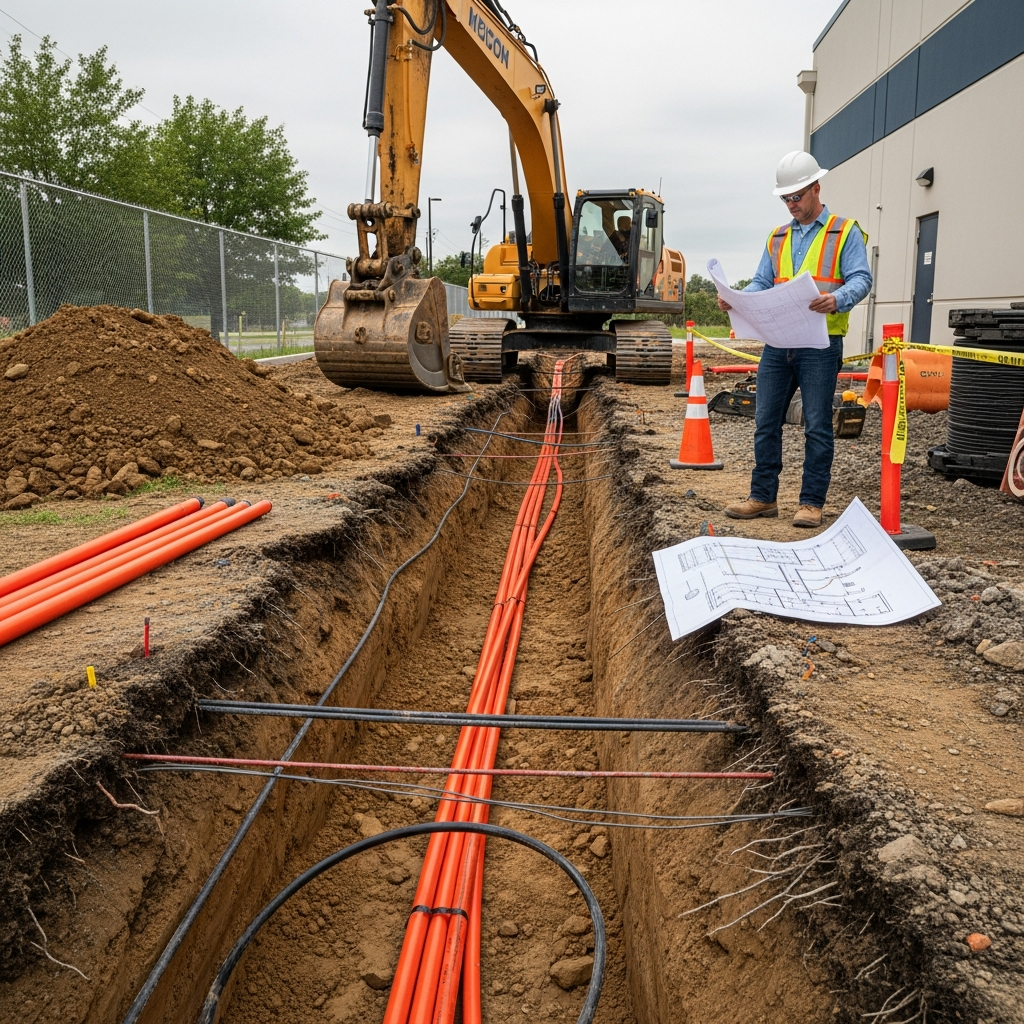
Walked onto a site last week where the foreman was standing over an open trench, prints in one hand, phone in the other. The drawings showed a clean underground run along the east edge of the lot. What was actually down there told a different story. Nobody panicked, but you could feel the day shifting.
The plans said the utility feed ran underground, clean and out of the way. Then we got to the site and found something completely different waiting for us in the dirt. That gap between what’s drawn and what’s actually buried is where most commercial commercial underground utility work gets complicated. It’s rarely as simple as digging a trench from point A to point B.
What happens when buried infrastructure doesn’t match the prints isn’t that different from a stalled vehicle blocking a lane. Everything stops. Crews wait. Schedules slide.
The part that frustrates me most is when general contractors treat the underground feed as a quick line item. It isn’t. Between locates, soil conditions, conduit depth requirements and coordinating with the utility, there’s a real plan behind every run. Skip a step and you’re tearing up concrete two months later.
For projects in Manatee, Sarasota or Hillsborough, we’d rather walk the site before bidding than guess from a drawing. New construction makes this easier. Even retrofits go smoother when somebody actually checks what’s down there. If you’re planning a build and the feed is going underground, get it scoped early. The trench is the cheap part. The redo isn’t.
steelcityelectricfl.com/underground electrical