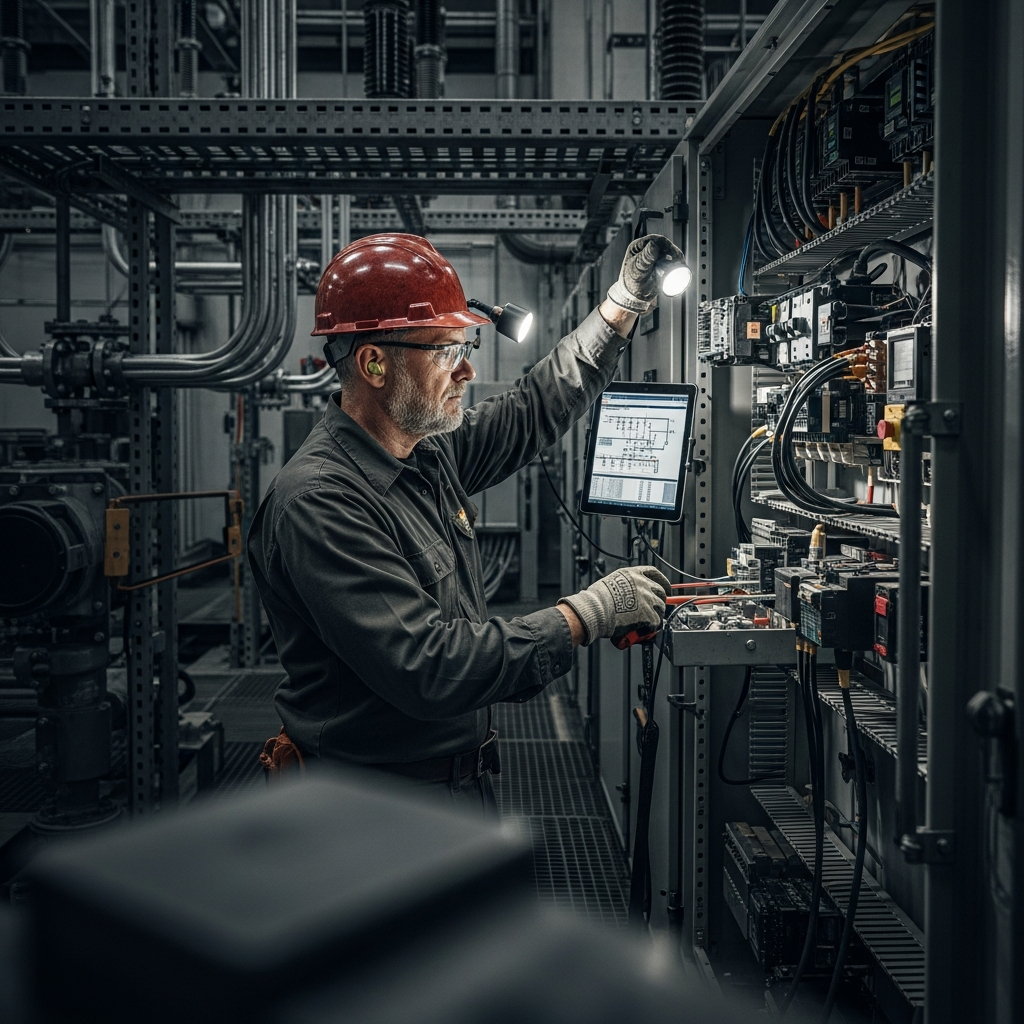
A commercial feeder going down is almost never just “a breaker went bad.” By the time the call gets made, the line is usually already quiet, pumps are sitting, PLCs are throwing faults, and maintenance is opening covers trying to sort out if the trouble is in the switchgear, the underground run, the utility feed, or the piece of equipment somebody started ten minutes ago. That is the part of commercial and industrial electrical repair people do not see from an office. It is hot gear, tight access, wet boxes, old labels, and someone asking how fast it can be fixed.
There is a place for better modeling. The recent power-grid-model 1.13.41 update pointed to more development in the Python and C++ library used for distribution power system analysis. Engineers use tools like that to study feeders, load behavior, and grid conditions before a bad night turns into a shutdown. Good information helps. It can show where a system is being leaned on too hard, especially in buildings that have added equipment for years without the service ever really being reworked.
Still, the drawing has to match what is in the dirt and on the wall. Steel City Electric has been in that kind of work before, including the All Points Equipment project in Palmetto. Crews installed underground conduit, an outdoor electrical panel, and the power infrastructure for industrial mixing equipment, lift stations, and silo operations. That job was not just wire in pipe. It meant trenching, coordinating utilities, planning load, feeding heavy equipment, and building something that could take the way the site actually runs day after day.
On repair calls, the cause is often ordinary and ugly. A lug backed off. A panel has been overloaded too long. Conduit took water. A disconnect burned up. A circuit was undersized from the start. Maybe the equipment changed and nobody updated the electrical. Production schedules do not matter much to failures like that. They show up when they want.
If a facility is dealing with nuisance trips, burned gear, voltage drop, pump problems, or repeated downtime, it is better to get eyes on the system before the next outage costs more than the repair. Steel City Electric handles commercial and industrial repair work for facilities that need the problem found, fixed, and documented without burning half a shift guessing.